

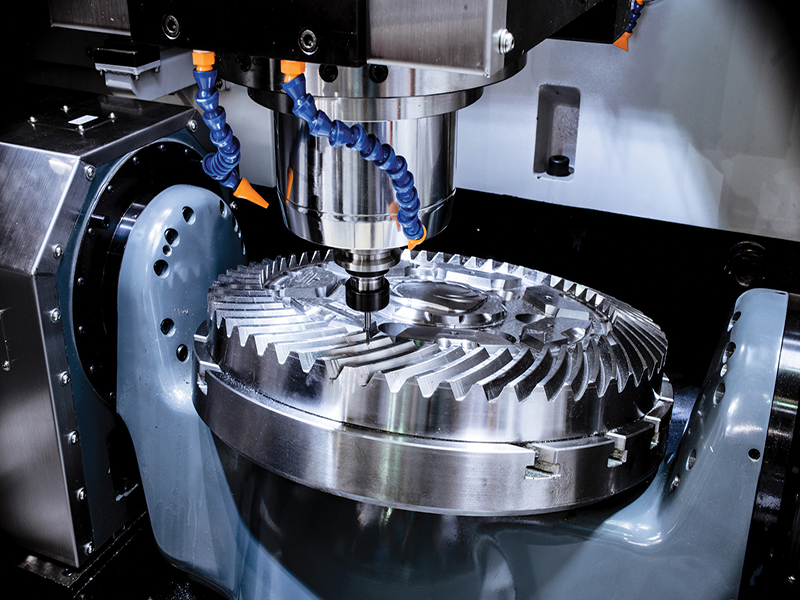
Investment approaches in the industrial sector are shifting: solutions that enhance CNC machine fleets with smart software and automation are gaining prominence, while the rise of industries requiring zero-error precision—such as aerospace—is accelerating this transformation. Tezmaksan CEO Hakan Aydoğdu emphasizes that CNC systems supported by smart technologies are boosting competitiveness and ushering in a new era of manufacturing.
The transformation in global manufacturing is reshaping investment priorities within the machine tool sector. While automotive investments slow down alongside the shift toward electric vehicles, sectors demanding high precision—such as aerospace—are becoming the new hubs of growth. Practices that upgrade existing CNC fleets with smart software and automation solutions, rather than investments in new machinery, are becoming the new drivers of efficiency and competitiveness in production. Noting that this transformation has become a prerequisite for remaining competitive, Tezmaksan CEO Hakan Aydoğdu stated that companies aiming to operate in industries requiring precision and error-free processing—particularly aerospace—must upgrade their existing production lines with smart technologies. Aydoğdu also noted that businesses unable to invest in new machinery could still significantly improve the efficiency of their existing infrastructure through software and automation solutions.
Manufacturing shifts its focus toward aerospace
Highlighting that the shift in production areas is the most significant indicator of the transformation within the machine tool sector, Aydoğdu said, “For many years, the automotive sector accounted for more than 50 percent of our machine tool sales; today, however, the aerospace industry—along with other sectors requiring precision machining—has surpassed that level. In 2021, Turkey reached the highest level of machine tool consumption in the history of the Republic, with a figure of approximately $2 billion. The sector has since settled into a new equilibrium, driven by the normalization of post-pandemic production demand and shifts in global manufacturing dynamics. In the first five months of the year, machine tool imports fell by 14 percent to $560 million, while exports declined by 12 percent to $244 million. Total machine tool consumption also decreased by 5.5 percent, settling at around $700 million. However, this situation is not unique to Turkey; a slowdown in the machine tool market is being observed worldwide. We do not view this picture negatively. In fact, the sector has returned to its natural pre-pandemic trajectory, and production has shifted toward higher technology—a trend mirrored globally. Industries such as aerospace, which require precision and error-free processing, demand production infrastructures equipped with advanced technology. Therefore, our industrialists need to prepare their existing production facilities for this transformation.” The investment map of cities is shifting
Noting that the transformation in the sector is also reflected in regional investment data, Aydoğdu said, “While automotive investments have slowed, investments in the aviation sector have gained momentum. Machine tool usage dropped by 50 percent in Bursa, whereas the decline was 14 percent in Istanbul. In contrast, there were increases of 200 percent in Eskişehir, 140 percent in Ankara, and 450 percent in Kırıkkale—cities where aviation manufacturing is concentrated. These figures clearly demonstrate a shift in the direction of production in Turkey. Consequently, automotive companies are also turning toward the aviation sector.”
“It is possible to enhance existing machinery instead of purchasing new equipment”
Pointing out that high financing costs have altered investment decisions, Aydoğdu said, “Just as elsewhere in the world, the difficulty of finding CNC operators stands at around 70% in Turkey. This drives manufacturers to enhance their existing production lines with robot and automation systems rather than investing in new machinery. In today’s competitive landscape, many manufacturers are focusing on boosting efficiency instead of purchasing new machines. Robot and automation systems enable existing machines to operate at higher capacities. By upgrading our CNC machinery with smart technologies, we make production planning more predictable and significantly reduce operator-related errors. The leasing mechanism offers manufacturers a significant financing advantage for machine tool investments. This makes it possible to invest at more favorable costs using foreign currency-based financing rather than facing high Turkish Lira interest rates.”
“Transitioning to automation has never been easier for SMEs”
Noting that the primary concern SMEs face regarding the transition to automation is the need for robot programming expertise, Aydoğdu stated that this barrier has been eliminated through the CubeBOX™ and RoboCAM+ solutions developed by Tezmaksan. Stating that SMEs have long perceived the use of robots as complex, Aydoğdu said, “Thanks to RoboCAM+, systems can be commissioned quickly without requiring robot programming expertise. Installation is completed in half a day, and the system can go into production on the same day following training. This allows repetitive, manual tasks to be automated. While the rate of operator-induced errors decreases, production becomes more sustainable and predictable. Furthermore, robotic production supports female employment; by automating tasks that require physical strength, women and young workers can play a greater role in production processes.”
“While there are 43 robots per 10,000 employees in Turkey, the global average stands at 116.”
Noting that Turkey has significant room for growth regarding automation investments, Aydoğdu said, “Although we lag behind the global average in robot density, Turkish industrialists are adapting rapidly to digital transformation. SMEs, in particular, are moving faster to adopt new technologies than their counterparts in many European countries. When automation is adopted, the geographical location of production becomes less critical; the ability to produce efficiently—rather than whether production takes place in China or Turkey—becomes the primary factor determining competitiveness. This presents a significant advantage for Turkey in its manufacturing transformation. While there are 43 robots per 10,000 employees in Turkey, the global average is 116, indicating that we still have a long way to go in automation. On a positive note, accessing these systems has become much easier than in the past; thanks to off-the-shelf solutions, leasing models, and new incentive mechanisms, SMEs can now easily transition to automation. With the European Union’s Carbon Border Adjustment Mechanism, efficient, traceable, and controllable production will shift from being a choice to a necessity. Investments in digital manufacturing technologies will soon evolve from a source of competitive advantage into a fundamental requirement for production. Last year, global investments in value-added manufacturing reached 1.8 times the level of investments in traditional manufacturing. Companies that keep pace with this transformation will continue to grow stronger, while those that fail to adapt will fall behind in the competition.”
Manufactured in Sivas, exported to 44 countries
Tezmaksan CEO Hakan Aydoğdu, noting that they have fully relocated their production operations from Istanbul to Sivas, stated: “Today, we export approximately 50 percent of our production to 44 countries and supply the remainder to the Turkish industrial sector. In fact, we had originally aimed to export 80 percent of our output. However, the rapid adaptation of Turkish industrialists to digital transformation and their shift toward automation investments drove domestic demand beyond our expectations. This situation demonstrates just how quickly Turkish industrialists are adapting to digital transformation. When you develop high-value-added machines, the world chooses you. One of the most concrete indicators of this is the continued growth of our exports in metal-cutting machine tools. While China dominates the global market for sheet metal processing machinery, Turkey is increasing its exports of metal-cutting machine tools. Multi-axis, high-precision manufacturing has become indispensable in the aviation sector. We plan to unveil the prototype of a turning center with at least nine axes—developed at our Sivas plant—at the MAKTEK 2026 Fair, to be held at the Istanbul Tüyap Fair and Congress Center from September 28 to October 3. Through this, we aim to write a new success story in both the domestic and export markets.”