

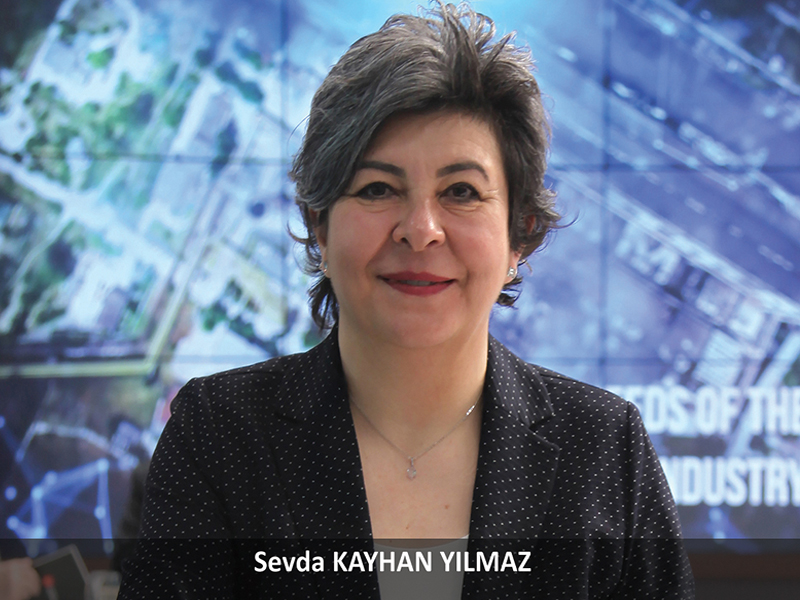
According to consolidated data from the Machinery Exporters' Association (MAİB), Türkiye's total machinery exports—including those from free trade zones—amounted to $16.5 billion in the first seven months of the year. Sevda Kayhan Yılmaz, President of the Machinery Exporters' Association, noted that the Turkish machinery sector has secured the top spot in the Syrian market—where total machinery imports doubled compared to the previous year—and stated, "The battle for market share between Chinese and European manufacturers is intensifying in the rapidly growing Syrian market. New regulations suited to competitive conditions are needed for the Turkish machinery sector, which captured market leadership by refusing to abandon the field even under the harsh conditions of the civil war."
Consolidated data for the machinery manufacturing industry shows that total machinery exports, including free trade zones, reached $16.5 billion during the seven-month period. Although there was a decline in volume, a 9% rise in export unit prices resulted in a 1.7% increase in value compared to the same period last year. The top two destinations for machinery exports were Germany—approaching the $2 billion mark with an 8.4% increase—and the USA, where exports rose by 28.9% to reach approximately $1.4 billion. Meanwhile, in the Syrian market, machinery exports neared $95 million, marking a 51.4% increase compared to the same period last year.
“The Turkish machinery sector has wrested market leadership in Syria from China.”
Pointing out that the process of Syria’s reconstruction and the revitalization of its civil industrial infrastructure has caused significant commercial potential to rise from the ashes, Sevda Kayhan Yılmaz, President of the Machinery Exporters’ Association, made the following remarks regarding the new competitive landscape emerging in the region:
“In the Syrian market—where annual machinery imports averaged $1.5 billion prior to the civil war—over a decade of devastating conflict had disrupted industrial investments, resulting in the squandering of significant commercial potential. However, as the country entered a recovery phase in 2025, Syria’s total machinery imports surged—doubling the previous year’s figure to reach $378 million—serving as concrete evidence of the accelerating momentum behind technological renewal and infrastructure needs on the ground. In this market, where the Turkish machinery sector ranked fifth in 2010, it overtook China to claim the top spot in 2025, with exports reaching $148 million—a 174.6% increase over the previous year. Yet, while demand grows for key industrial machinery—particularly in the metal, plastic, food, and textile sectors—the battle for market share among Chinese and European manufacturers is intensifying. New measures tailored to competitive conditions are now required for the Turkish machinery sector, which secured market leadership by remaining active on the ground even amidst the harsh conditions of the civil war.”
“It is high time for Syria to be removed from the list of high-risk countries.”
Highlighting that the trade corridors revitalized through the efforts of the Turkish and Syrian governments—alongside the medium-term goal of achieving $10 billion in bilateral trade—provide a highly favorable foundation for this surge, Yılmaz stated the following:
“To maintain the strong position we have secured in the Syrian market—even amidst the crisis—we must withstand the aggressive, state-backed financing strategies employed by our competitors. This depends on deploying financing instruments that bolster our operational capabilities on the ground. However, the fact that Syria is classified in ‘Category 7’—the highest risk tier in Turkish Eximbank’s risk assessment—imposes significant financial and bureaucratic hurdles on our exporters in the form of high premium rates. Furthermore, the unavailability of the Buyer’s Credit mechanism grants a substantial financing advantage to our competitors, particularly those from Europe. In this new era, as the devastating effects of the war begin to recede and reconstruction budgets come into play, such restrictive practices pose risks that limit the operational scope of businesses. We believe the time is right to remove Syria from the list of high-risk countries designated by Eximbank. We advocate for greater flexibility in export credit insurance processes and the urgent development of market-specific Eximbank support mechanisms. These measures—designed to alleviate the risk premium burden on exporters and strengthen their competitive edge—would not only safeguard the Turkish machinery sector’s leading presence in the region but also enable us to contribute far more effectively to Syria’s reconstruction process.”
“We will hold one-on-one meetings with Syrian companies in Damascus”
Stating that they have been consulting with member companies to identify the challenges exporters face in trade with Syria, Yılmaz concluded his remarks as follows:
“The tenfold increase in per-ton taxes at Syrian customs and the application of the same customs tariffs to Turkish products as those from East Asia have significantly impacted some of our sub-sectors. In particular, machinery that is inherently massive in bulk has begun to incur double costs due to customs duties based on both weight and value. Another operational issue concerns the variety of available payment channels. Since direct banking channels are not functioning, transfers made to our country via currency exchange bureaus result in exporters missing out on foreign currency conversion incentives. We are aware that these are not unsolvable issues and that our ministries are working towards a gradual solution. At this juncture, what matters is remaining active on the ground and ensuring that Syrian buyers are not swayed by our competitors. To this end, we are meticulously preparing for the 63rd Damascus International Fair—scheduled for late August—where Turkey will organize a national participation pavilion. During our engagements in Damascus, we will personally explain to Syrian companies how a commercial partnership with Turkey creates a win-win model.”