

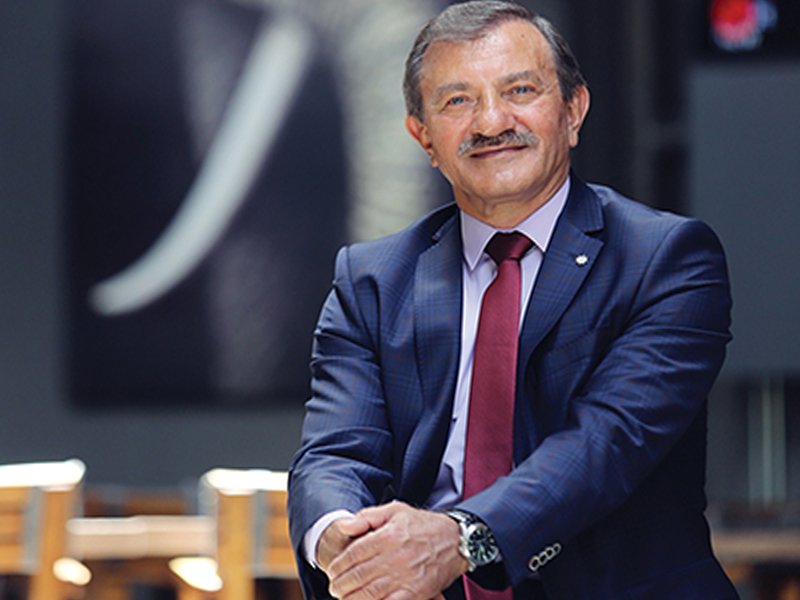
Ömer Karadeniz, Chairman of the Board of PLASFED, stated that the Deposit Management System is not merely an environmental protection measure, noting, "Every piece of packaging thrown in the trash represents a strategic raw material lost to the national economy." Karadeniz highlighted that the system would reintegrate 25 billion packaging units into the economy annually, resulting in savings of approximately 30 billion liras, and emphasized that this figure represents only the beginning of the economic contribution the system will provide to the industry. He further stated that the true value-add would emerge from reintroducing recyclable waste into production as high-quality secondary raw material.
The Deposit Management System (DYS), implemented across Turkey, has ushered in a new era for the separate collection of packaging waste at the source and the supply of high-quality raw materials to the recycling industry.
Ömer Karadeniz, Chairman of the Board of the Plastics Industrialists Federation (PLASFED), noted that the system would reintegrate the high-quality raw materials needed by the recycling sector into the economy, stating, "Every recyclable package we throw in the trash today is essentially an economic loss for our country. We must now collect raw materials, not waste."
Karadeniz, President of the umbrella organization PLASFED, described the Deposit Management System as a historic step for the plastic recycling sector and stated the following:
"As the plastics industry, we have never viewed waste simply as trash. Every recyclable package is a valuable raw material that can be reintroduced into production. Today, every piece of plastic, glass, or metal packaging that ends up in the trash represents value lost to the economy. In other words, we are throwing our money away. Thanks to the Deposit Management System, PET beverage packaging, in particular, will be collected in a much cleaner, sorted, and recyclable state. This will improve the quality of recycled raw materials, increase their usage rate in production, and contribute significantly to reducing the need for imported raw materials."
"The 30-billion-lira saving is just the beginning of the real gain."
Karadeniz stated that the economic gain of approximately 30 billion liras to be achieved through the Deposit Management System represents only the visible portion of the total value-added the system will generate. Noting that reintegrating 25 billion packages into the economy annually holds strategic importance for the recycling industry, Karadeniz explained that the system would enable recycling facilities to access higher-quality raw materials, reduce production costs, and save on energy and natural resource consumption. Pointing out that—in addition to increased resource efficiency—reintroducing recyclable raw materials into production would reduce dependence on imported raw materials, Karadeniz emphasized that the announced 30-billion-lira saving is merely the starting point of the actual economic contribution the system will provide to the industry. Noting that Türkiye possesses one of Europe's most robust plastic recycling infrastructures, Karadeniz added that the Deposit Management System would make a significant contribution to the more efficient use of existing capacity.
"KAS and DYS will achieve success together"
Noting that PLASFED has long advocated for the widespread adoption of the Source-Separation System (KAS), Karadeniz stated that the Deposit Management System (DYS) is one of the most important complements to this approach. Karadeniz concluded his remarks as follows:
"The deposit system is a crucial step. However, true success will only be achieved when the culture of source separation becomes widespread across all segments of society. Collecting recyclable waste separately in homes, workplaces, and all living spaces will ensure that the high-quality raw materials required by the industry are sustainably reintegrated into the economy. When the Source-Separation System and the Deposit Management System work in tandem, products currently viewed as waste will be transformed into high-value economic resources."